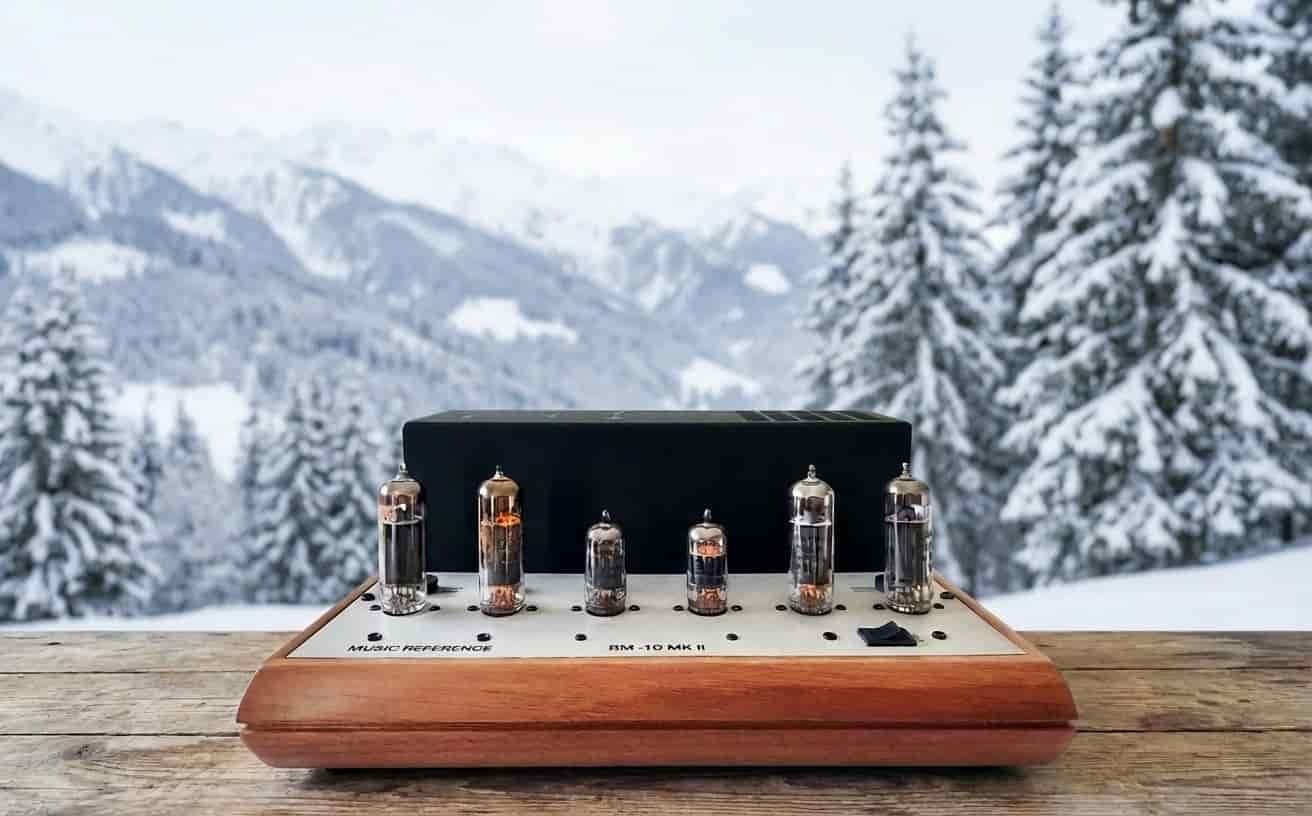
This month we continue our discussion of the RM-10 amplifier. Last edition, we discussed how Roger achieved 35 watts per channel with a pair of EL-84 tubes, a first in the industry. At the time, other designers needed twice as many tubes to achieve 35 watts. In addition, those designs consumed 200+ watts at idle which shortens component life. In contrast, the RM-10 consumed 70 watts at idle, another first. At a bias current of 30 mA per pair the idling dissipation is 9 watts or 75% of rating. Tube life was estimated to be 5,000 to 10,000 hours if the amplifier is played below clipping at the recommended bias setting.
Some of you knowledgeable about circuit design might correctly point out that higher idling current reduces distortion. To counter this, Roger designed his circuits to be what he termed “light loaded” which reduces the output current demand on the tubes making them more linear. The only negative is a loss of about 20% of the power rating (1 dB). With the RM-10, “light loading” is achieved by connecting the speaker to the tap that is 1/2 its rating. For example, connecting an 8-ohm speaker to the 4-ohm tap. So, if you are willing to have fewer watts, you will get 78% less distortion, a reserve current of 80%, double the damping, less noise, and longer tube life. So much for needing that higher idling current.
When one sees the small output transformers on the RM-10 you would be further challenged to believe that the amplifier could achieve 35 watts, let alone do so and provide any meaningful bass. Roger often spoke of the RM-10’s miraculous output transformers that were the result of ten years of his musings on output transformer design. He carefully chose a balance of copper and iron to achieve wide bandwidth and low magnetic distortion. Since there is less iron to magnetize, there is less insertion loss. The power transformer winding configuration provides a higher degree of regulation capable of 250 watts which translates to 400% over its demand at typical music listening levels resulting in stable imaging and solid impact transients.
Roger’s unique design for monoblock operation of the amplifier is worth noting as well. Solid state amplifiers are normally bridged into mono, but the same does not apply to tube amplifiers. The term "bridging" only applies to transistor amplifiers. When transistor amplifiers are "bridged" the input of one channel is inverted and the load is connected across the hots. Ideally power is doubled in this situation. Typically, converting a stereo tube amplifier to mono operation also results in doubling of power, but the tap impedances are cut in half. With the RM-10, a 4-ohm speaker on the 8-ohm tap gets you double the power. An 8-ohm speaker on the 8-ohm tap will not get you double the power though you will get double the current.
Connecting stereo tube amplifiers to mono requires gain matching within a few tenths of a decibel. If not gain matched the two channels will fight each other. Dynaco solved this problem by requiring two power resistors in series with each 8-ohm output. That certainly did the trick but did not do the damping factor any favors. Also, switching the Dynaco into mono only made the inputs mono, so it only did half the job. Roger designed what he referred to as “Driver Mono” for the RM-10 that connects the driver into an internal mono mode. This is preferable to the common practice of “Y” connecting the inputs and outputs which requires exact matching of the left and right drivers. A pair of RM-10 amplifiers operated as monoblocks produces 50 watts with an 8-ohm load on the 8-ohm tap, or 70 watts with a 4-ohm load on the 8-ohm tap.
Now about the RM-10 MkIII. A year before Roger died he mused about how the cost of the RM-10 reached a price point he never imagined it would reach. So, I did the math for Roger. We started with the original MSRP and factored in the cost of inflation over time. Turns out the calculation ended up within $200 of the price of the latest cathode self-bias RM-10 MkII (a redesign error by Roger in my opinion, but that is another story). Well Roger was not going to accept that even though he knew the numbers were correct. Instead, he went on a mission to redesign the RM-10 to a price point that was 60% less than the 2018 price of the amplifier.
One of the most difficult compromises Roger made was that the amplifier could not be point-to-point wired, unless we outsourced overseas. So, a circuit board would replace point-to-point wiring. Roger saw value in this as he was impressed by how far the quality of circuit board materials had come since he last used them. Also, Roger was thinking of this as a DIY project as well and offering a kit version. So, overall, the circuit board made sense. Now Roger had to make another decision regarding hand winding the output transformers. Given his health and lack of anyone else suitable to do the task, Roger decided they would not be hand wound in house, but he found a suitable alternative to have them wound to his specifications.
Now before any of you start crying blasphemy regarding Roger’s decision on the transformers, let me set the record straight. Other than the occasional one-off or small batch project, the only amplifiers that had hand wound output transformers were the RM-200T, RM-9 Special Edition, the last ten RM-200 MkIIs made, and the ill-fated cathode self-bias RM-10 MkII. Of those, the vast majority were not personally hand wound by Roger himself, but in-house wound by apprentices under his supervision. Any other RM-9, RM-10, and RM-200 amplifier had manufactured machine wound transformers, albeit selected by Roger based on his design requirements or manufactured per his data sheet specifications. Hopefully this clears the air.
Unfortunately, Roger died before he could complete the redesign. Even more unfortunate is that costs have risen in the last six years and while we will come in under the 2018 price point, we cannot fulfill Roger’s desired price point. Even the kit will come in over that number. We used Roger’s design philosophy regarding parts selection for the RM-10 MkIII. You will not find boutique or otherworldly parts in this amplifier, but rather parts selected to do the job properly and to ensure reliability and serviceability. An example are the tube fuses. Roger used to fume when one of his amplifiers came in for repair with so-called boutique “audiophile approved” fuses installed (you audiophiles know which ones I am referencing). So, in the RM-10 MkIII we went with plug-in fuses for which there can be no “audiophile approved” substitute.
Another design decision Roger made was to eliminate the stereo/mono capability, so the RM-10 MkIII will only be a stereo amplifier. This one was even difficult for me to accept, and Roger and I debated over this quite a bit. For some perspective, Roger had grown weary of designing high-powered amplifiers. One, they were not easy to manufacture, two they were heavy, and three, Roger always felt low power amplifiers operated within their limits and driving properly matched speakers were superior to high power amplifiers. Back to our debate, Roger ended the discussion by saying, “35 watts ought to be enough power for anybody.” The RM-10 MkIII looks much the same cosmetically, although the wood frame will be beefier. The top plate is still made by Neal Feay, and we still have a good stock of the original transformer and tube covers.
I hope you enjoyed learning about the history and design elements of the RM-10. To continue Roger’s legacy and to bring this amplifier back into the public eye, we hope to have fully built RM-10 MkIII amplifiers for sale soon. However, there are still challenges to sort out. Making audio equipment is not easy, especially components like amplifiers. It is not just the build itself, but customer support and service as well. There is a lot of time and risk involved and margins are constantly shrinking. I will be honest, it might not be worth the risk, but one way or the other we hope to resolve all this shortly.
Special Audiophile Foundation Offer
On December 11, 2025, the sixth anniversary of Roger’s passing we will make a limited number of RM-10 MKIII kits available for sale exclusively to Audiophile Foundation members. The price will be $1,650 for a complete kit which includes all circuit parts (excluding tubes), hardware, plates, frame, and transformers. The build level is rated as difficult, and you should consider yourself to have advanced DIY skills and the proper equipment to do the job. I do not plan to write a detailed instruction booklet, although I will provide something. You will get a schematic, bill of materials, and test data sheet. There will be no contact for support so consider yourself on your own. Visit the RAM Tubes website (
www.ramtubes.com) starting on December 11, 2025, to view the offer.
In addition, for every kit purchased a $250 donation will be made to the Audiophile Foundation by RAM Tubes. Purchase a kit and help support the foundation.