Between Measurements and Emotion: How AI Is Redefining the Audiophile Listening Journey
Manrique Zuniga | Published on 3/1/2026
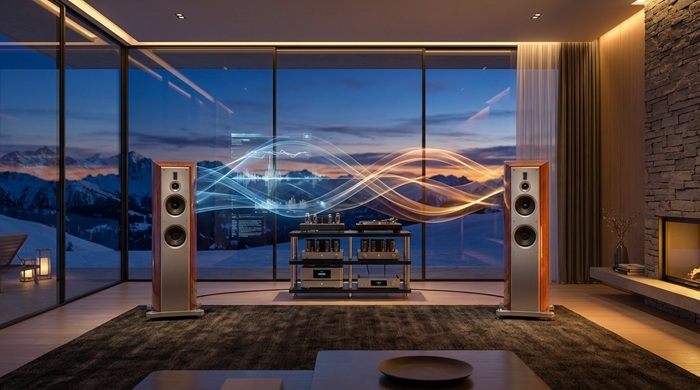
During a recent Audiophile Foundation Friday Night “Happy Hour Zoom Call,” our group dove into how artificial intelligence (AI) shapes audiophile decisions. AI now weaves into daily life, automating chores and delivering instant insights. Yet, harnessing AI wisely is key to unlocking its true value.
Audiophile choices have long been a delicate dance between cold science and warm intuition. We trust logic—measurements, specs, reviews—but experience reveals how swiftly certainty fades. Two amps may measure alike, yet one pulses with life. A lauded headphone may leave us unmoved, while a hidden gem captures our hearts. Between charts and the listening chair, emotion softly claims the stage.
Now AI is entering that space, not to replace human judgment, but to expose how fragile—and fascinating—our decision-making process really is.
At a surface level, AI looks like a natural extension of the tools audiophiles already use. Machine learning can analyze vast libraries of frequency response data, distortion measurements, room interactions, and preference curves in seconds. According to an article on Headphones.com, AI can help sift through information by retrieving definitions, summarizing specifications, and providing overviews, making it easier for hobbyists to filter out the noise in a field crowded with details.
But the deeper impact of AI has less to do with gear and more to do with the listener.
Audiophiles often talk about preferences as fixed identities: neutral, warm, analytical, musical. In reality, our behavior tells a more complicated story. We buy equipment that impresses us technically, then sell it because it’s fatiguing. We claim to value accuracy, yet repeatedly gravitate toward sound signatures that soften edges or add body. AI excels at noticing these patterns without ego or attachment. In a 2024 paper by Tran and colleagues entitled "Transformers Meet ACT-R: Repeat-Aware and Sequential Listening Session Recommendation," they describe how modern AI recommendation systems use Transformer-based architectures to learn from users’ listening sessions and patterns, allowing them to closely model individual music preferences over time. This capability can feel unsettling to some people. There’s comfort in believing our tastes are deliberate and well understood. AI challenges that assumption by holding up a mirror: not what we say we like, but what we consistently choose to live with.
Nowhere is this more powerful than in the long-standing tension between objective measurements and subjective listening. Audiophiles have argued for decades over which matters more. AI sidesteps the argument by correlating the two. When thousands of listeners describe a sound as “harsh” or “smooth,” AI can identify the measurable traits that most often accompany those impressions. Subjective language becomes less abstract, more anchored in reality, without losing its emotional nuance.
A downside with AI that must be addressed is the false information that exists online and the inability of AI (in its present form) to distinguish truth from fiction. Unreliable comments online can skew the true reputations of a given speaker, amplifier, or DAC to the point where we do not know what to rely upon. An individual with a vested interest can “hear” the life-changing sound difference in a given piece of equipment that might be marginal at best. AI swallows this information up, the good and the bad. We should use AI with caution and perhaps just as a starting point on our journey for audio knowledge. One must not rely solely on AI, or we fall prey to misinformation. However, some may argue that as AI systems advance, their ability to cross-reference sources and detect inconsistencies can help mitigate the impact of misinformation over time. For instance, future models may incorporate credibility assessments or transparency features that flag questionable data. Still, these safeguards are not foolproof and cannot fully replace critical human evaluation. In the end, our ears should lead us to nirvana.
AI also brings clarity to one of the hobby’s most uncomfortable truths: diminishing returns. High-end audio is filled with incremental improvements that may or may not matter in real-world listening. AI can factor in your room, listening volume, music preferences, and hearing sensitivity to show where upgrades are likely to be audible—and where they’re mostly theoretical. It doesn’t kill desire; it removes illusion.
Perhaps most exciting is how AI reshapes discovery. Instead of pushing the most popular or hyped products, AI-driven recommendations can surface gear that aligns with your specific listening profile—even if it rarely trends online. The hobby becomes less about consensus and more about fit.
In the end, AI won’t tell you what sounds best. It will help you understand why you prefer what you prefer. In a pursuit defined by careful listening, that kind of self-awareness may be the most meaningful upgrade yet.
Continue the discussion...
If you enjoyed this article, members can continue the discussion in the "How are you using, or will you use, AI to help you with audio-related decisions?" thread in our Forums.